Collagen and Gut Health: What the Evidence Actually Shows (and What's Still Unproven)
Quick Answer: Collagen contains amino acids (like glycine and glutamine) that play a role in gut lining structure, and some small studies suggest a supportive effect on gut barrier function, but current evidence in humans is limited and mostly preliminary — collagen isn’t proven to “heal” the gut lining the way some marketing implies, though it’s a reasonably low-risk supplement to try if you’re curious.

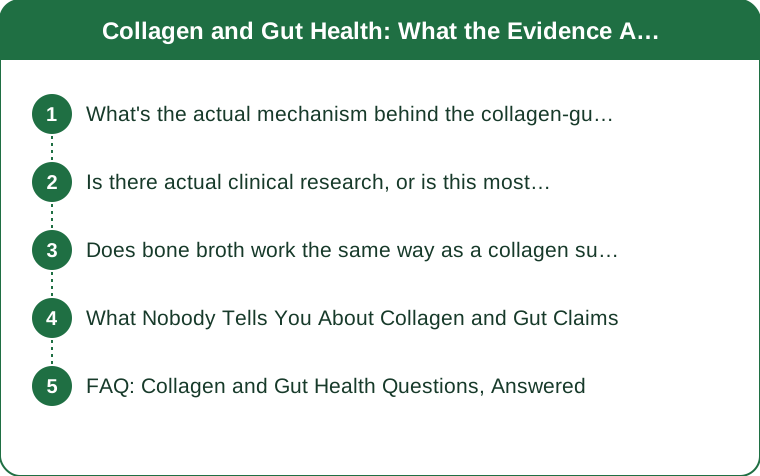
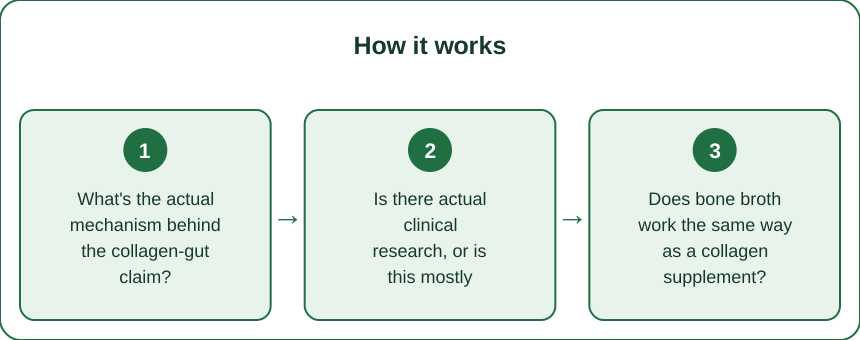
What’s the actual mechanism behind the collagen-gut claim?
Collagen supplements provide amino acids, particularly glutamine and glycine, that the intestinal lining uses as fuel and structural building blocks. The theory is that supplying more of these amino acids could support gut barrier integrity, but having the raw materials available isn’t the same as proving supplementation measurably improves gut function in most people.
Is there actual clinical research, or is this mostly anecdotal?
There is some clinical research, but it’s limited in scale — small human studies and a larger body of animal research suggest a plausible supportive effect, but large, well-controlled human trials specifically on collagen and gut health outcomes are still lacking. This is a case where the theoretical mechanism is stronger than the current direct evidence.

Does bone broth work the same way as a collagen supplement?
Bone broth contains collagen along with other nutrients, but the actual collagen content varies significantly by how it’s made (cooking time, bone type), making it a less standardized source than a measured collagen supplement. Neither has been proven definitively superior for gut health specifically — the evidence gap applies to both.
What Nobody Tells You About Collagen and Gut Claims
Most collagen marketing conflates “contains amino acids the gut can use” with “clinically proven to heal your gut,” which oversells the current evidence. That doesn’t mean collagen is useless — the amino acid profile is genuinely relevant to gut tissue — but framing it as a proven fix rather than a plausible, still-being-studied support is where the marketing outruns the science.
FAQ: Collagen and Gut Health Questions, Answered
How long would you need to take collagen before noticing any gut-related change?
Studies that have shown effects generally used consistent daily supplementation for at least several weeks to a couple months — there’s no solid evidence supporting a quick or short-term gut benefit from occasional use.
Are there better-evidenced supplements for gut health than collagen?
Probiotics and fiber have considerably more robust human research behind them for gut health outcomes specifically, making them a stronger evidence-based starting point if gut health is the primary goal.
Is collagen safe to take alongside probiotics or fiber supplements?
Generally yes, there’s no known negative interaction, and some people combine them, though doing so doesn’t mean the combination is proven more effective than either alone.
TL;DR:
- Collagen provides amino acids relevant to gut lining structure, but proof is preliminary
- Human clinical evidence specifically on gut outcomes is still limited in scale
- Bone broth’s collagen content is inconsistent and not more proven than supplements
- Probiotics and fiber currently have stronger evidence for gut health specifically
Collagen isn’t a proven gut fix, but it’s a plausible, low-risk addition — just keep expectations calibrated to where the evidence actually stands today.
Keep Reading
This article is for general informational purposes only and is not medical advice. Always consult a qualified health professional for guidance specific to you.