Fiber Supplements vs Food Fiber: What Actually Differs
Quick Answer: Most fiber supplements deliver one isolated fiber type — usually psyllium, inulin or methylcellulose — which is excellent for stool form and regularity but feeds a narrow slice of your gut bacteria. Food fiber arrives as a mixture of several fiber types plus polyphenols and resistant starch, which supports a broader microbial community. Supplements solve a bowel problem well; they are a poor substitute for dietary variety.
Both have a place. The mistake is assuming a scoop replaces the vegetables.

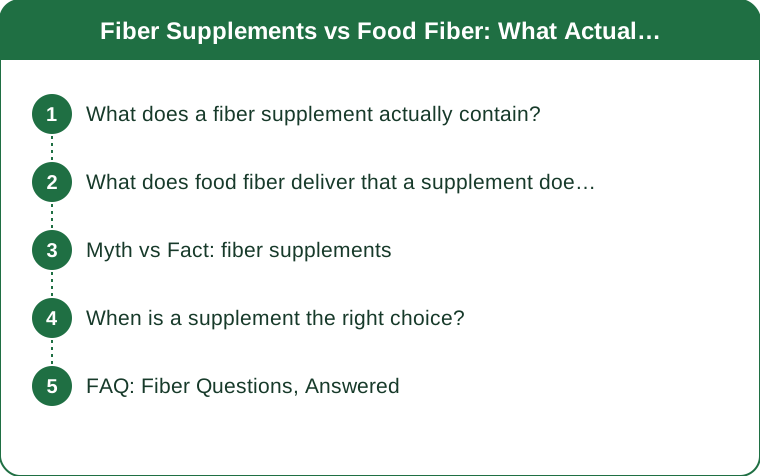
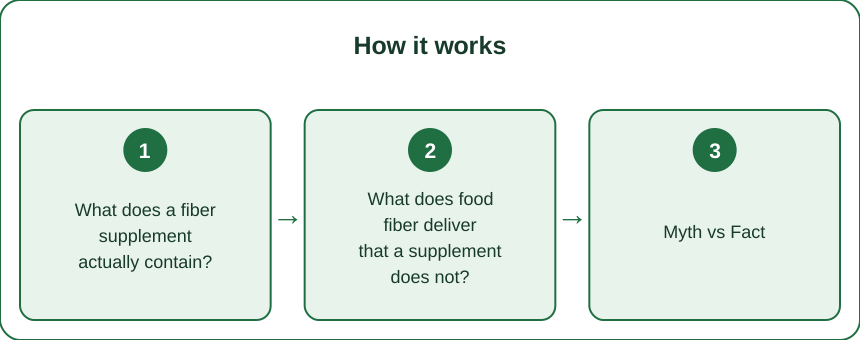
What does a fiber supplement actually contain?
One fiber, usually, and which one determines what it does.
Psyllium husk. A gel-forming soluble fiber. It absorbs water, forms a viscous gel, and normalizes stool in both directions — it softens hard stool and firms loose stool, which is unusual and genuinely useful. It is only partially fermented, so it produces less gas than most other soluble fibers. It also has the best evidence base of the common supplements for cholesterol reduction.
Inulin and FOS. Highly fermentable prebiotic fibers, usually from chicory root. They feed bifidobacteria specifically and reliably increase their numbers. They also produce the most gas and bloating of any common fiber supplement, and people with IBS frequently do badly on them.
Methylcellulose. A synthetic, non-fermentable bulking fiber. Adds bulk with essentially no gas. Also feeds essentially nothing — your microbiome gets nothing from it.
Wheat dextrin. Soluble, well tolerated, mixes clear. Modest effects on stool form compared to psyllium.
The pattern: each supplement is one tool doing one job. None of them is “fiber” in the sense that a plate of food is.
What does food fiber deliver that a supplement does not?
Four things, and only the first is fiber.
A mixture of fiber types. A single serving of beans contains soluble fiber, insoluble fiber, resistant starch and oligosaccharides. Different gut bacteria specialize in different substrates, so a mixed input supports a broader community than an isolated one. Microbiome diversity is one of the more consistent markers associated with gut health, and dietary plant variety is the strongest dietary predictor of it.
Resistant starch. Found in cooked-and-cooled potatoes and rice, legumes, green bananas and oats. It ferments in the colon to produce butyrate, the short-chain fatty acid that colon cells use as their primary fuel. Most fiber supplements contain none.
Polyphenols. Plant compounds that arrive attached to the fiber matrix and are metabolized by gut bacteria into active compounds. Berries, tea, cocoa, olive oil, herbs. A fiber supplement strips these out entirely.
The food matrix itself. Fiber inside intact plant cell walls slows digestion differently than free fiber powder does, which affects satiety and glucose response. Whole almonds and almond flour behave measurably differently even at identical fiber content.
The bottom line: supplements are a fiber delivery mechanism. Food is a fiber plus everything else delivery mechanism.

Myth vs Fact: fiber supplements
Myth: A fiber supplement means you do not need to eat vegetables.
Fact: It covers the bowel-regularity function and very little else. The microbiome diversity, polyphenol and micronutrient contributions of plants are not in the scoop.
Myth: More fiber is always better.
Fact: Adding a large amount of fiber quickly, especially fermentable fiber, reliably produces bloating, gas and discomfort. Increase by roughly 5 grams a week and increase fluid alongside it. And for a subset of people with certain constipation patterns, more fiber makes things worse, not better.
Myth: All prebiotic fibers are good for everyone.
Fact: Inulin and FOS are high-FODMAP and are among the most common triggers for people with IBS. “Prebiotic” is a description of what a fiber does for bacteria, not a promise about how you will feel.
Myth: Fiber supplements work immediately.
Fact: Stool form changes usually take three to seven days of consistent use, and microbiome shifts take considerably longer. Judging a supplement after two days is the most common reason people cycle through four of them.
Myth: Taking fiber with a meal blocks nutrient absorption.
Fact: Viscous fibers can modestly reduce absorption of some minerals and can interfere with the absorption of certain medications — which is why the standard advice is to separate fiber supplements from medication by about two hours. For nutrients from a normal diet, the effect is not clinically meaningful for most people.
When is a supplement the right choice?
Five situations where reaching for the tub is the correct call.
1. Constipation that food changes have not resolved. Psyllium has strong evidence here and works faster than dietary overhaul.
2. Loose or unformed stool. Psyllium’s gel absorbs excess water and is one of the few interventions that genuinely helps in both directions.
3. A restricted diet. If you are on a low-FODMAP protocol, an elimination diet, or a medically restricted intake, a well-chosen non-fermentable supplement fills a gap that food currently cannot.
4. A genuinely low baseline. If you are getting 10 grams a day and the target is 25 to 30, a supplement bridges the gap while you work on food — and doing both is far more realistic than expecting a sudden dietary transformation.
5. Cholesterol management, as an adjunct. Psyllium has reasonably consistent evidence for modest LDL reduction. This is a conversation to have with your clinician rather than a self-prescribing decision.
When food is the better answer: general gut health, microbiome diversity, energy, satiety and long-term outcomes. None of those are supplement problems.
The practical combination most people land on: food as the base, a supplement for a specific symptom, and the supplement reassessed every few months rather than taken forever by default. This is general information, not medical advice.
FAQ: Fiber Questions, Answered
How much fiber do I actually need?
Common guidance sits around 25 grams a day for women and 30 to 38 for men, and most people in Western countries get roughly half of that. The variety of sources matters as much as the total — a frequently cited target is 30 different plants a week, counting herbs, nuts, seeds and grains.
Will a supplement cause bloating?
Depends entirely on the type. Methylcellulose and psyllium produce relatively little gas; inulin and FOS produce a lot. If you bloated on one supplement, that is not a verdict on fiber — try a different class before giving up.
Does cooking destroy fiber?
No. Fiber survives cooking. Cooking changes fiber’s physical structure and can change resistant starch content — cooking and then cooling potatoes, rice or pasta actually increases resistant starch, which is one of the easier free wins available.
TL;DR:
- Most supplements are one isolated fiber: psyllium for stool form, inulin for bifidobacteria and gas, methylcellulose for bulk with no fermentation.
- Food delivers mixed fiber types plus resistant starch, polyphenols and an intact food matrix.
- Increase fiber by about 5g a week with more fluid, and expect three to seven days before stool changes.
- Supplements are the right call for constipation, loose stool, restricted diets and low baselines.
- Plant variety — around 30 different plants a week — is the lever a scoop cannot pull.
Use the supplement for the symptom and the food for the system. They are not competing for the same job.
Keep Reading
This article is for general informational purposes only and is not medical advice. Always consult a qualified health professional for guidance specific to you.