What Artificial Sweeteners Actually Do to Your Gut Microbiome
Quick Answer: Some research suggests certain artificial sweeteners can shift gut bacteria composition in ways that may affect blood sugar regulation for some people, though the effect size and individual variation are significant — it’s not a universal or dramatic disruption for everyone who consumes them.
Artificial sweeteners get talked about as either totally harmless or a gut health disaster, and the honest answer sits in the messier middle, with real nuance that gets lost in either extreme framing.
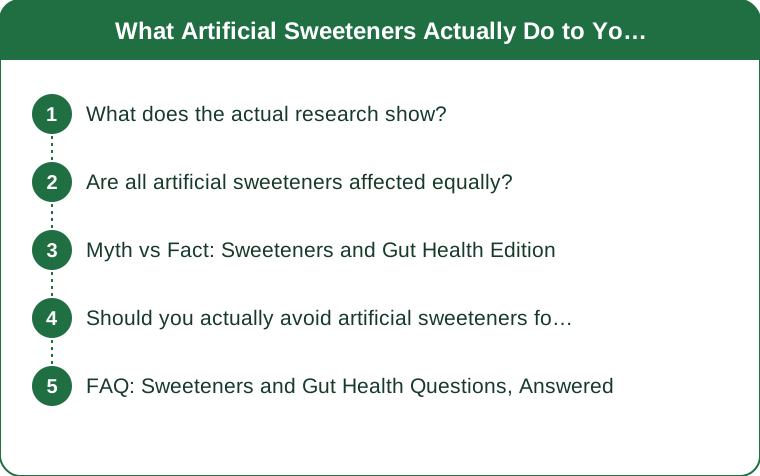
What does the actual research show?
Several studies have found that certain sweeteners (particularly saccharin and sucralose in some research) can alter the relative abundance of certain gut bacteria species in a subset of people, with some studies linking this to changes in glucose tolerance.
Importantly, individual response varies substantially — some study participants showed notable microbiome shifts and blood sugar changes, while others showed minimal to no measurable effect from the same sweetener and dose, suggesting personal gut composition plays a role in sensitivity.
Are all artificial sweeteners affected equally?
No — research findings differ by specific sweetener. Saccharin and sucralose have more studies suggesting a microbiome effect than aspartame, which has less consistent evidence of gut bacteria disruption in current research.
Stevia and monk fruit, both natural non-nutritive sweeteners, generally show less evidence of microbiome disruption in existing studies, though research on these is still comparatively limited compared to synthetic sweeteners.

Myth vs Fact: Sweeteners and Gut Health Edition
Myth: All artificial sweeteners definitively harm gut health. Fact: evidence varies significantly by sweetener type and shows meaningful individual variation — it’s not a settled, universal conclusion.
Myth: Because they’re calorie-free, sweeteners have zero biological effect. Fact: calorie-free doesn’t mean metabolically inert — some sweeteners do interact with gut bacteria and taste receptors in ways still being studied.
Myth: Natural sweeteners like stevia are automatically gut-neutral. Fact: current evidence suggests fewer effects than some synthetic sweeteners, but ‘natural’ doesn’t inherently guarantee zero interaction with gut bacteria — more research is still needed here too.
Should you actually avoid artificial sweeteners for gut health?
If you have known digestive sensitivity or existing gut health concerns, moderating sweetener intake — especially saccharin and sucralose — is a reasonable, low-cost precaution given current evidence, even though the science isn’t fully settled.
For most people without specific gut issues, occasional consumption within typical usage ranges (a diet soda now and then, sweetener in coffee) isn’t strongly supported as a major gut health risk based on current research.
FAQ: Sweeteners and Gut Health Questions, Answered
Do artificial sweeteners cause bloating directly?
For most people, no — bloating from sweetened products is more often linked to sugar alcohols (like xylitol or erythritol) than to non-nutritive sweeteners like sucralose or aspartame, which work through a different mechanism.
Is it the sweetener or the sweetened product causing gut issues?
Both are possible — some diet products also contain other ingredients (certain fibers, emulsifiers) that independently affect digestion, so isolating the sweetener as the sole cause isn’t always accurate.
How much sweetener is considered ‘moderate’ consumption?
There’s no single universal number, but staying within a product’s suggested serving size and avoiding multiple heavily sweetened products daily is a reasonable, practical guideline given current research uncertainty.
TL;DR:
- Research on sweeteners and gut bacteria shows real effects for some people, but significant individual variation, not a universal conclusion
- Saccharin and sucralose have more evidence of a microbiome effect than aspartame, stevia, or monk fruit
- Bloating from diet products is often from sugar alcohols, not the sweetener itself
- Moderation is a reasonable approach if you have existing gut sensitivity, without needing total avoidance
The honest takeaway is nuance, not alarm — if your gut feels fine with sweeteners, current evidence doesn’t demand you change that.
Keep Reading
This article is for general informational purposes only and is not medical advice. Always consult a qualified health professional for guidance specific to you.