How Long It Actually Takes to Feel Gut Health Changes After Fixing Your Diet
Quick Answer: Some gut symptoms (bloating, irregular digestion) can improve within days to two weeks of a clear dietary change, but meaningful shifts in gut microbiome diversity typically take 4-6 weeks of sustained change, and some benefits continue building for 3+ months — the timeline genuinely depends on which symptom and mechanism you’re targeting.
Gut health content often implies a single universal timeline, but symptom relief, microbiome shift, and inflammation reduction all move at different speeds through different mechanisms.

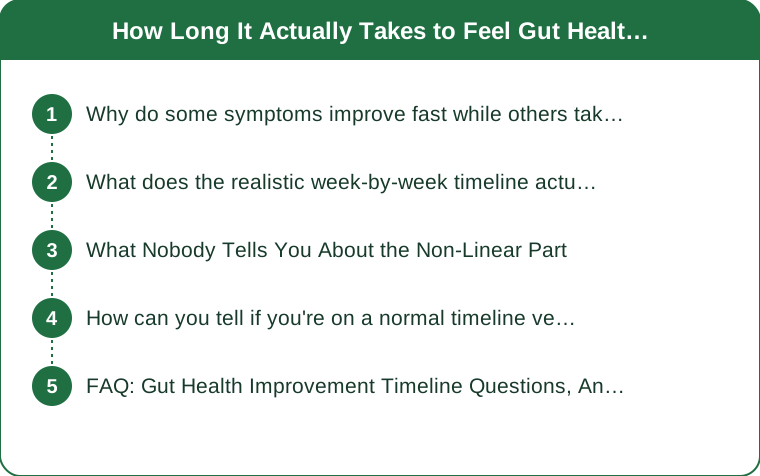
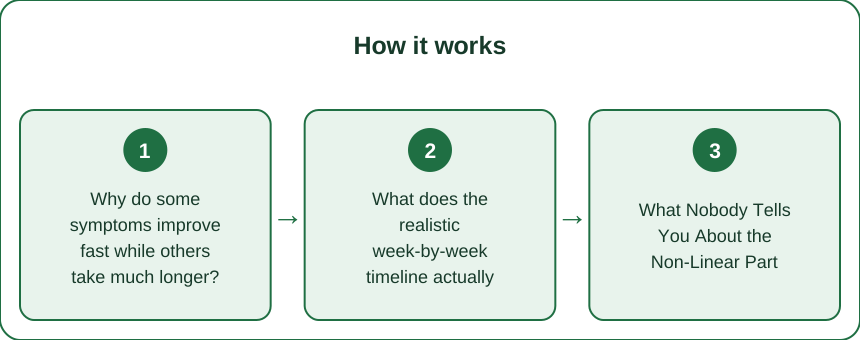
Why do some symptoms improve fast while others take much longer?
Immediate digestive symptoms — bloating, gas, irregular bowel habits — often respond quickly to removing an identified trigger food (like a specific FODMAP or dairy, for someone sensitive) because the mechanical and inflammatory response to that food stops almost immediately once it’s removed.
Microbiome composition changes, on the other hand, require actual shifts in bacterial population ratios, which happen through sustained dietary pressure over weeks — a single fiber-rich week doesn’t meaningfully reshape a gut microbial community that took years to establish its current balance.
What does the realistic week-by-week timeline actually look like?
- Days 1-3: Minimal change, sometimes temporary worsening (especially with sudden fiber increases, which can cause gas as digestion adjusts)
- Days 4-14: Direct symptom relief from removed trigger foods often becomes noticeable; increased fiber-related bloating typically starts settling
- Weeks 3-6: Early microbiome shifts become measurable in research settings; many people notice more consistent energy and digestion
- Months 2-3+: More stable, established changes; some benefits (like improved short-chain fatty acid production from fiber-fed bacteria) continue building over this longer window

What Nobody Tells You About the Non-Linear Part
Here’s what catches people off guard: improvement often isn’t a smooth upward line — many people experience a temporary worsening of symptoms (more gas, some bloating) in the first week of significantly increasing fiber or fermented foods, before things improve, because gut bacteria populations are shifting and some produce more gas as they adjust to new fuel sources.
This temporary dip leads a lot of people to conclude the change “isn’t working” and quit right before the actual improvement phase, which is one of the most common and avoidable reasons gut health changes get abandoned early.
How can you tell if you’re on a normal timeline versus something needs adjusting?
A reasonable check-in point is 2-3 weeks — if there’s been zero improvement or symptoms are getting steadily worse (not just an initial adjustment bump) by that point, it’s worth reconsidering whether the specific change (fiber type, eliminated food, probiotic strain) is actually right for your situation, rather than assuming you just need more patience indefinitely.
Persistent significant symptoms — pain, blood, unintended weight loss, symptoms disrupting daily life — deserve a doctor’s evaluation regardless of timeline, rather than continuing to self-adjust diet alone.
FAQ: Gut Health Improvement Timeline Questions, Answered
Does everyone experience the initial adjustment bloating phase?
Not universally — it depends on how significant the dietary change is and individual gut sensitivity, but a sudden large increase in fiber or fermented foods causes this in a meaningful portion of people, so it’s worth expecting rather than being alarmed by.
Can probiotics speed up the timeline?
Some evidence supports certain probiotic strains helping specific symptoms faster, but they’re not a universal shortcut — the food-based dietary changes (fiber diversity, reduced trigger foods) tend to matter more for lasting microbiome change than a supplement alone.
Is 3 months long enough to know if a change is actually working?
For most dietary interventions, yes — if there’s been no meaningful improvement by 3 months of consistent effort, it’s a reasonable point to reassess the approach or consult a doctor or dietitian rather than continuing the same plan indefinitely.
TL;DR:
- Symptom relief and microbiome change move at different speeds — days to weeks for symptoms, weeks to months for microbial shifts
- A temporary worsening (more gas, bloating) in week one of dietary change is common, not a sign it’s failing
- 2-3 weeks is a reasonable checkpoint to see if a change is heading the right direction
- Persistent significant symptoms deserve a doctor’s evaluation regardless of how long you’ve been trying dietary changes
This is general information, not medical advice — ongoing or severe symptoms are worth a professional evaluation rather than more self-directed dietary experimentation.
Keep Reading
This article is for general informational purposes only and is not medical advice. Always consult a qualified health professional for guidance specific to you.