Why Your Gut Feels Different When the Seasons Change
Quick Answer: Seasonal gut changes are real and come from four things shifting at once: what you eat, how much you move, how much daylight you get, and your stress load. Autumn typically brings more cooked and starchy food, less activity, less light affecting sleep and circadian rhythm, and schedule stress — each of which independently affects digestion. Most seasonal bloating resolves by adjusting fiber gradually and protecting sleep timing.
Every September your digestion changes and you assume you ate something.
The more likely explanation is that four separate inputs to your gut all shifted within the same three weeks, and their effects stacked.

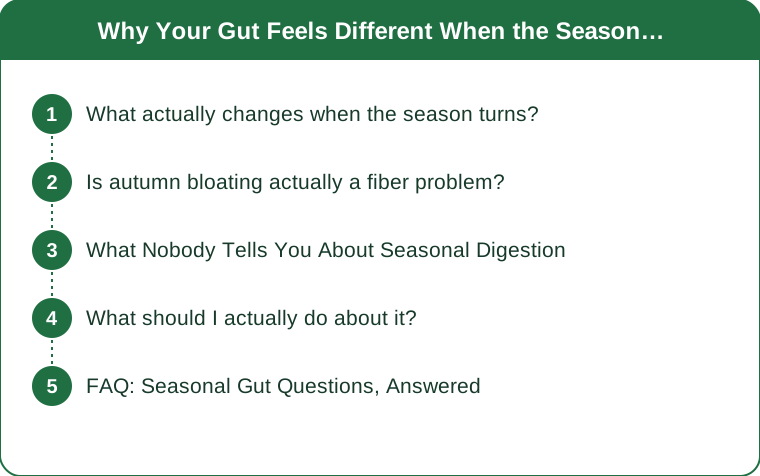
What actually changes when the season turns?
1. Your food changes more than you notice. Summer eating skews toward raw produce, salads, and cold food. Autumn shifts toward cooked vegetables, grains, root vegetables, and legumes — a different fiber profile entirely.
Cooked fiber behaves differently from raw fiber, and a jump in resistant starch from potatoes, beans, and cooled grains commonly produces gas for a few weeks until the gut microbiome adjusts.
2. You move less. Physical activity directly affects gut motility — movement helps move contents through, and a drop in daily steps as the weather turns is one of the most reliable seasonal changes there is.
A 2,000-step daily reduction is enough to slow transit noticeably in many people, and almost nobody connects the two.
3. Light exposure drops, and with it your circadian rhythm shifts. The gut runs on a circadian clock like everything else — digestive enzyme output, motility, and microbiome composition all follow daily rhythms. Less morning light shifts sleep timing, which shifts meal timing, which shifts all of it.
4. Stress load changes. The return of school schedules, work intensity after summer, and shorter days all contribute. The gut-brain connection is direct and well documented, and stress-related symptoms are among the most common seasonal complaints.
These stack. Any one is manageable; four at once within a month is what produces the sense that something is suddenly wrong.
Is autumn bloating actually a fiber problem?
Usually a fiber change problem rather than a fiber amount problem.
Your gut bacteria adapt to what you regularly feed them. A summer of salads and fruit builds one community; a sudden shift to beans, squash, and whole grains asks a different set of bacteria to do the work. That adaptation takes roughly two to four weeks and gas is the byproduct in the meantime.
The specific culprits: legumes, cruciferous vegetables, onions, and cooled starches like potato salad or leftover rice. All are genuinely good for you and all reliably produce gas when introduced quickly.
The fix is pace, not avoidance. Increase fiber by roughly 5g per week rather than jumping. A single autumn bean chili after a summer of salads is a large step change for your microbiome.
Water matters more as fiber goes up. Increasing fiber without increasing fluid is a common cause of the constipation that follows a healthy-eating resolution. Roughly an extra 250ml per additional 5g of fiber is a reasonable rule of thumb.
Cooling starches deliberately — cooking potatoes or rice and refrigerating them — increases resistant starch, which is beneficial and gassy in equal measure. Worth doing, worth introducing slowly.

What Nobody Tells You About Seasonal Digestion
Meal timing shifts more than meal content in autumn, and the gut cares about timing. Later dinners as evenings darken compress the overnight fasting window, and that window is when a meaningful portion of gut housekeeping happens.
Morning light affects your gut, not just your mood. Circadian alignment influences motility and the microbiome. Ten to fifteen minutes of outdoor light within an hour of waking is a legitimate digestive intervention, which sounds implausible and is well supported.
Bloating that is worse in the evening is usually normal. Abdominal distension increases through the day in most people. Comparing your evening stomach to your morning stomach is the single most common source of unnecessary worry.
Alcohol intake often rises in autumn and winter and it affects the gut lining and the microbiome directly. This is frequently the unexamined variable when symptoms appear seasonally.
Hydration drops when it gets cold because thirst signaling decreases. Most people drink noticeably less in October than in July without noticing, and dehydration is a straightforward cause of constipation.
Comfort food is not the villain it is made out to be. Warm cooked food is generally easier to digest than raw. The issue is speed of change and portion size, not the food category.
Some seasonal variation is simply normal. Your gut is not supposed to behave identically in January and July. Chasing perfect consistency across seasons is a losing project, and mild variation is not a condition to be treated.
What should I actually do about it?
Increase fiber gradually — about 5g per week, not all at once. If you have already jumped, back off slightly and rebuild over three weeks.
Drink more than feels necessary. Cold weather suppresses thirst, and the amount of water you drank in August is not being matched now. Keep a bottle visible.
Protect your step count. Whatever your summer baseline was, aim to stay near it. A walk after dinner does double duty — motility and light exposure at once.
Get morning light. Fifteen minutes outside within an hour of waking, even on an overcast day. Outdoor overcast light is far brighter than indoor lighting and it anchors your circadian rhythm.
Keep meal timing consistent. Especially dinner. An overnight fast of 12 hours or so supports gut motility patterns and is easier to hold than it sounds.
Give it three weeks before concluding anything. Most seasonal adjustment resolves in that window. Changing five things at once makes it impossible to know what helped.
When to see a doctor: blood in stool, unintentional weight loss, persistent pain, symptoms that wake you at night, or any significant change lasting more than a few weeks. Seasonal explanations should never be used to dismiss those.
This is general information, not medical advice.
FAQ: Seasonal Gut Questions, Answered
Is it normal for digestion to change with the seasons?
Yes. Diet, activity, light exposure, and stress all shift seasonally and each affects the gut independently. Mild variation is expected rather than a sign of a problem.
Should I take a probiotic when the season changes?
Evidence for general seasonal probiotic use is thin. Fermented foods and a varied plant intake have better support and are cheaper. A specific probiotic strain for a specific documented issue is a different conversation, worth having with a professional.
Why does cold weather make me constipated?
Usually reduced water intake and reduced movement rather than temperature itself. Both are fixable and both are commonly overlooked.
How long does it take for my gut to adjust to a new way of eating?
Meaningful microbiome shifts begin within days and settle over roughly two to four weeks. Symptoms during that window are adaptation, not intolerance — though genuine intolerance exists and does not improve with time.
TL;DR: Four inputs change at once, and only one of them is what you ate.
- Food shifts from raw to cooked and starchy — a different fiber profile your microbiome needs weeks to adapt to.
- Steps drop, and movement directly drives gut motility. A 2,000-step decline is enough to notice.
- Less morning light shifts your circadian rhythm, and your gut runs on that clock too.
- Increase fiber by 5g a week, not all at once, and add water alongside it.
- Thirst drops in cold weather — most people are quietly drinking less than in summer.
- See a doctor for blood, weight loss, night pain, or symptoms lasting weeks. Seasonal is not an explanation for those.
Start with a fifteen-minute walk after dinner. It handles motility, light, and steps in one move.
This is general information, not medical advice.
Keep Reading
This article is for general informational purposes only and is not medical advice. Always consult a qualified health professional for guidance specific to you.