How Much Does Chewing Actually Change Your Digestion?
Quick Answer: Chewing does three things that genuinely matter - it increases the surface area your digestive enzymes can work on, it starts carbohydrate digestion via salivary amylase, and it slows the meal down enough for satiety signals to arrive. The third is the largest effect for most people. The famous thirty-times rule has no real basis; the practical target is chewing until the food has no texture left, which is usually 15-25 chews for most foods and considerably fewer for soft ones. Eating fast is associated with more bloating, more reflux, and higher intake - and slowing down is the single highest-return change most people can make.
What it will not do is fix a genuine digestive condition, and it is worth separating those two things clearly.

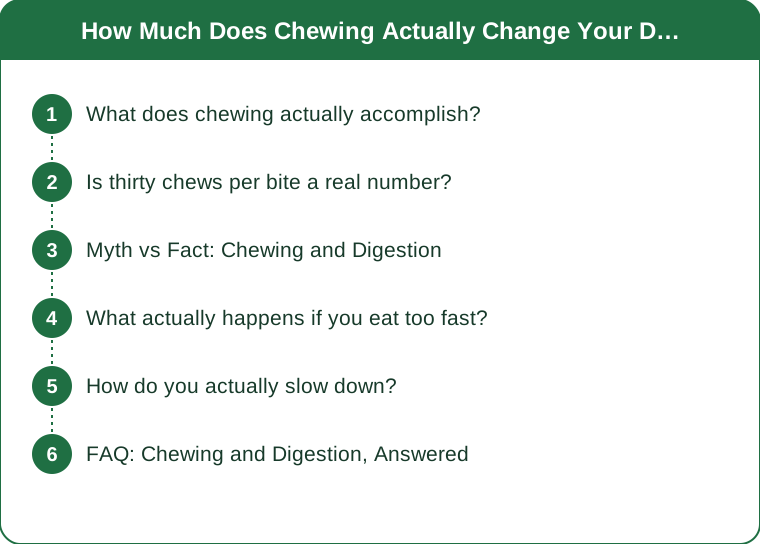
What does chewing actually accomplish?
Three mechanisms, of very different sizes.
Mechanical breakdown, which is the obvious one. Smaller particles mean more surface area for stomach acid and enzymes. Large food particles genuinely take longer to break down and are more likely to move into the small intestine incompletely digested, where they can ferment and produce gas.
Salivary amylase starts carbohydrate digestion in the mouth. This is real, and it is one reason bread starts tasting sweet if you hold it long enough. The effect is modest - most carbohydrate digestion happens further down - but it is not nothing.
Time is the biggest one. Satiety signals take roughly 15-20 minutes to register. Eating a meal in eight minutes means you finish before your body has told you how much you have eaten. This is the mechanism behind fast eating and higher intake, and it is much larger than the enzymatic effect.
A fourth, less discussed: swallowing air. Fast eating means more aerophagia - swallowed air - which is a straightforward and very common cause of bloating and belching that has nothing to do with the food itself.
And chewing signals the rest of the system. The act of chewing triggers the cephalic phase of digestion - saliva, stomach acid, and enzyme release begin before food arrives. Eating on autopilot while distracted blunts that preparation.
Is thirty chews per bite a real number?
No, and its origins are more interesting than its evidence.
The number comes from Horace Fletcher, an early 20th-century figure who advocated chewing each mouthful until it liquefied - often far more than thirty times. It was a wellness movement, not a research finding, and it has been repeated ever since without anyone checking.
The real answer depends entirely on the food. A piece of steak might genuinely need 25-30 chews; a spoonful of yoghurt needs two or three. A fixed number applied across all foods is either far too many or pointlessly few.
The better rule: chew until there is no texture left. When you cannot identify distinct pieces with your tongue, it is ready. This self-adjusts for every food and takes no counting.
Typical figures if you want them: soft foods 5-10, most cooked vegetables and grains 15-20, meat and raw vegetables 20-30, nuts and fibrous raw foods 30+.
Counting is useful once, as calibration. Count for one meal to find out where you actually are - most people are shocked to find they swallow after five or six chews. Then stop counting and use the texture rule.
What matters more than the count: total meal duration. Twenty minutes for a main meal is the target that captures nearly all the benefit.
Myth vs Fact: Chewing and Digestion
Myth: Chewing more will fix your bloating. Fact: It helps with the aerophagia and large-particle components, which are real contributors. It will not fix bloating driven by IBS, food intolerance, SIBO, or constipation. If bloating is severe, daily, or new, that is a medical question - this is general information, not medical advice.
Myth: Drinking water with meals dilutes your stomach acid and impairs digestion. Fact: Not meaningfully. Stomach acid production adjusts, and water leaves the stomach quickly. Drinking with meals is fine and helps some people slow down.
Myth: You should not eat while walking or standing. Fact: Posture is not the issue; attention and speed are. Eating while walking tends to be fast and distracted, which is the actual problem.
Myth: Chewing gum aids digestion. Fact: It stimulates saliva and gastric secretions with no food arriving, and it makes you swallow air. For people prone to bloating, gum is often a contributor rather than a help.
Myth: Soup and smoothies do not need chewing so they digest better. Fact: They digest fine but they bypass the satiety and cephalic-phase benefits almost entirely - which is why liquid calories are famously unsatisfying. Chewing something alongside them helps.

What actually happens if you eat too fast?
Several documented consequences, and the pattern is consistent.
Higher intake. People eating the same meal quickly consume more before feeling full than those eating slowly. The 15-20 minute satiety lag is the whole mechanism.
More reflux. Fast eating means larger volumes arriving at once and more air swallowed, both of which increase pressure and reflux likelihood. Eating quickly then lying down or sitting back is the classic trigger.
More bloating and belching, from swallowed air.
A larger glucose response, in some studies - the same meal eaten quickly produces a bigger spike than the same meal eaten slowly.
Less enjoyment, which is not a trivial point. Meals eaten fast are barely tasted, and eating slowly is one of the few health behaviours that improves the experience rather than costing something.
Who eats fastest: people eating alone, people eating at a desk, people eating while looking at a screen, and parents eating around small children. These are situational rather than personal, which means they are fixable by changing the situation rather than trying harder.
How do you actually slow down?
Environmental changes work; willpower does not.
Put the fork down between bites. The single most effective mechanical trick. You cannot load the next bite while chewing the current one, and that alone can double meal duration.
Use a smaller utensil. A teaspoon instead of a tablespoon, or chopsticks. Smaller bites need less chewing each but take more of them, and the meal stretches naturally.
Eat something that requires chewing first. Starting with a salad or raw vegetables sets a slower pace for the rest of the meal.
Remove the screen. Not for moral reasons - screen eating measurably increases intake and reduces the memory of having eaten, which affects how hungry you are later.
Set a twenty-minute marker. Not a timer to obey, just a reference. If your main meal is finished in eight minutes, that is the number to move.
Eat with other people when you can. Conversation is the most natural pace-setter there is.
Pick one meal, not all of them. Dinner is usually the easiest and it is also the meal where slowing down does the most, because evening eating tends to be the fastest and the largest.
And be realistic about the seasonal shift: as routines change in autumn - darker evenings, more meals indoors, busier schedules - eating tends to get faster and more distracted. It is a good moment to set the habit deliberately rather than let it drift.
FAQ: Chewing and Digestion, Answered
Will chewing more help me lose weight?
Indirectly and modestly, by reducing intake through better satiety signalling. It is a supporting habit, not a strategy.
Does it help with acid reflux?
Often, yes - smaller volumes arriving more slowly and less swallowed air both reduce pressure. Combine it with not lying down for two to three hours after eating.
I have dental problems and cannot chew well. What can I do?
Focus on food preparation instead - cooking things softer, cutting smaller, blending where appropriate - and get the dental issue addressed, because chronic poor chewing does affect what you can eat and therefore your diet quality overall.
Does chewing more help with gas?
For gas from swallowed air, yes. For gas from fermentation of fibre or FODMAPs in the large intestine, no - that is a different mechanism and chewing does not touch it.
Should I chew liquids?
The advice to chew your drink and drink your food is overstated, but swishing a smoothie briefly does start amylase activity and slows consumption. Mostly it is a slowing-down device.
When should I see a doctor?
Persistent bloating, difficulty swallowing, pain when eating, unexplained weight loss, or a change in bowel habit that lasts more than a couple of weeks. Chewing advice is not the answer to any of those. This is general information, not medical advice.
TL;DR:
- Chewing does three things: increases surface area, starts amylase digestion, and slows the meal down - the third is by far the biggest.
- Thirty chews is a 1900s wellness slogan, not a finding. Chew until there is no texture left - usually 15-25 for most foods.
- Total meal duration matters more than the count. Twenty minutes for a main meal captures nearly all the benefit.
- Fast eating means more intake, more reflux, more swallowed air, and a bigger glucose response.
- Fix it environmentally: fork down between bites, smaller utensil, no screen, eat with people.
- It will not fix IBS, intolerance, or persistent bloating - those are medical questions.
The useful reframe is that this is not really about chewing. It is about the twenty minutes, and chewing is just the most reliable way to get there.
Keep Reading
This article is for general informational purposes only and is not medical advice. Always consult a qualified health professional for guidance specific to you.