Taking Your Probiotic at the Wrong Time Can Cancel Out Most of Its Benefit
Quick Answer: Probiotics generally work best taken on an empty stomach or right before a meal, digestive enzymes need to be taken with the first bite of food, and fiber supplements should be spaced at least 2 hours away from other medications or supplements to avoid absorption interference.
The supplement itself is fine. The timing is usually where the actual benefit gets lost, and it’s rarely mentioned on the label in any useful detail.

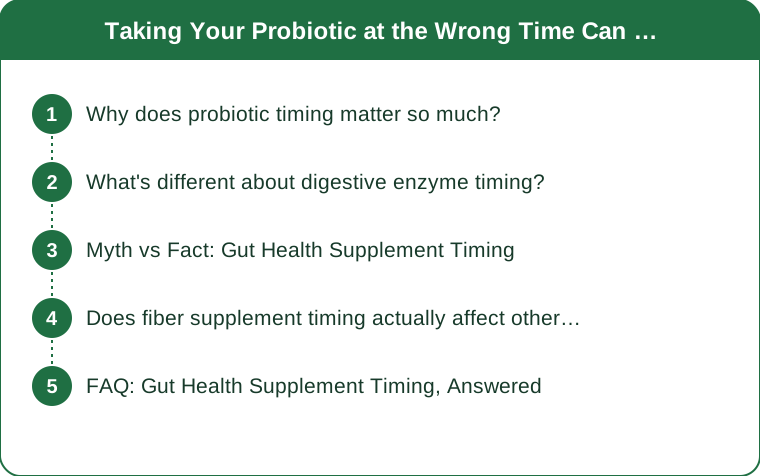
Why does probiotic timing matter so much?
Stomach acid is at its lowest concentration on an empty stomach or right before eating, giving live bacterial cultures a better chance of surviving the trip to the intestines where they’re actually needed. Taking probiotics with or right after a large meal exposes them to peak stomach acid, killing off a significant portion before they can do anything.
What’s different about digestive enzyme timing?
Unlike probiotics, digestive enzymes need to be present exactly when food arrives to break it down effectively — taking them significantly before or after a meal misses the digestive window they’re meant to support. Right before or with the first bite is the standard guidance.

Myth vs Fact: Gut Health Supplement Timing
Myth: More probiotic CFUs always means better results regardless of timing. Fact: A high CFU count taken at the wrong time can still result in most of the bacteria dying in stomach acid before reaching the gut.
Myth: All supplements can be taken together for convenience. Fact: Fiber supplements can bind to and reduce absorption of some medications and other supplements if taken too close together — spacing matters.
Myth: Probiotic timing doesn’t matter if the strain is ‘acid-resistant.’ Fact: Acid-resistant strains do survive better, but timing still improves outcomes even for these — it’s not an either-or.
Does fiber supplement timing actually affect other medications?
Yes — soluble fiber supplements can physically bind to certain medications in the digestive tract, reducing how much gets absorbed. A general rule of spacing fiber supplements at least 2 hours away from medications and other key supplements avoids this interference.
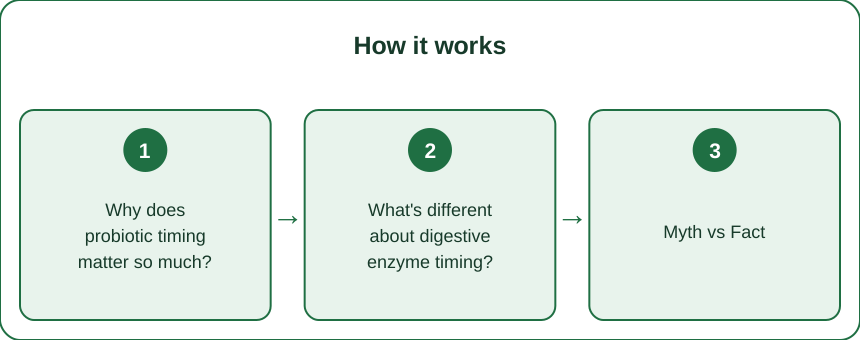
FAQ: Gut Health Supplement Timing, Answered
Is morning or evening better for taking a probiotic?
Either works, as long as it’s on an empty stomach or right before a meal — consistency in timing matters more than which time of day is chosen.
Should probiotics be taken with a fatty meal for better absorption?
No — unlike fat-soluble vitamins, probiotics don’t need dietary fat for absorption; an empty stomach or light meal timing works better for survival through stomach acid.
Can taking probiotics and digestive enzymes at the same time cause problems?
Generally not a major issue, though separating them by even 30 minutes lets each work under its optimal digestive conditions.
TL;DR:
- Probiotics survive stomach acid better on an empty stomach or right before a meal
- Digestive enzymes need to be taken with the first bite of food to work as intended
- Fiber supplements can interfere with medication absorption — space them out by 2+ hours
- Consistent timing matters more than time of day for most gut supplements
The supplement was probably never the problem — the timing quietly was.
Keep Reading
This article is for general informational purposes only and is not medical advice. Always consult a qualified health professional for guidance specific to you.