Why Training Harder Suddenly Upsets Your Stomach
Quick Answer: Hard exercise diverts blood away from the gut to working muscle — by a substantial margin at high intensity — which slows digestion, impairs absorption and irritates the intestinal lining. Add mechanical jostling, dehydration, and the fact that people who start training harder usually also change what they eat, and gut symptoms are close to predictable. The main levers are timing food further from the session, reducing fibre and fat pre-workout, and ramping intensity more gradually than you want to.
You add two sessions a week and suddenly your stomach is a daily topic.
This is a well-described physiological response, not a sign that something is wrong with you.

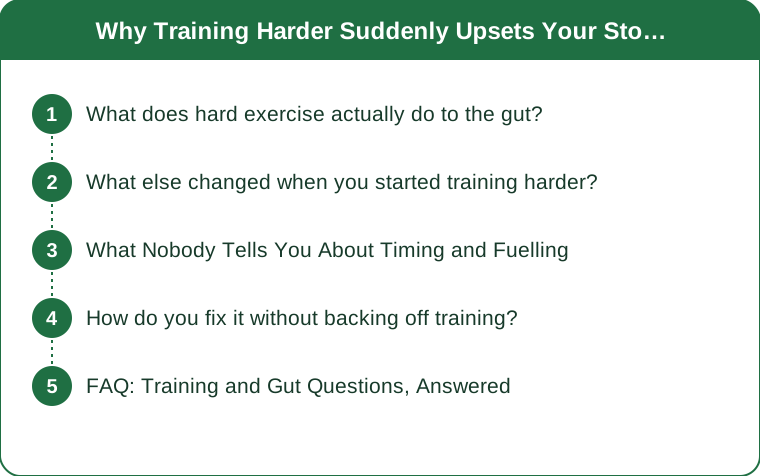
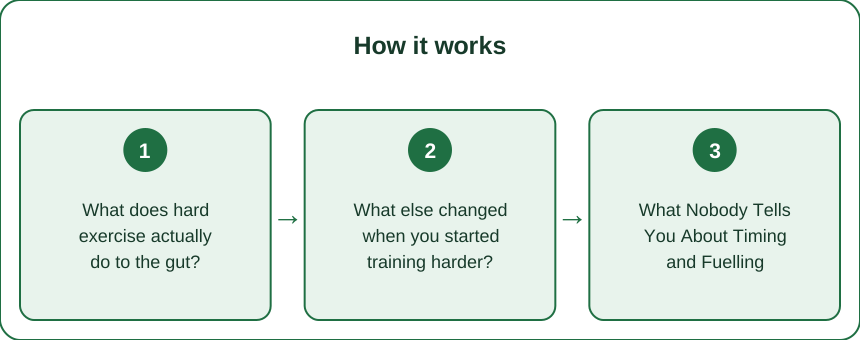
What does hard exercise actually do to the gut?
Four mechanisms, which usually arrive together.
Blood flow redistribution is the main one. During intense exercise the body prioritises working muscle, and splanchnic blood flow — the supply to the gut — drops substantially, with reductions of well over half reported at high intensities. Less blood means slower gastric emptying, reduced absorption and a stressed intestinal lining. This is why symptoms scale so clearly with intensity rather than duration.
The intestinal barrier becomes temporarily more permeable. Reduced blood flow and heat stress loosen the junctions between intestinal cells. This is transient and normal, and it contributes to the cramping and urgency that endurance athletes describe. It is also why symptoms are worse in heat.
Mechanical jostling matters for some activities and not others. Running produces repeated impact that physically agitates the gut, which is why runners report far more symptoms than cyclists or lifters at equivalent effort. If your symptoms appeared when you added running specifically, that is likely a large part of it.
The autonomic shift changes motility. Exercise is a sympathetic — fight or flight — state, and digestion is a parasympathetic function. Hard training suppresses digestive activity during the session and there is a rebound afterwards, which is why some people get symptoms an hour after finishing rather than during.
And moderate exercise does the opposite. Gentle activity improves motility and is one of the better things you can do for a sluggish gut. The problems are specific to high intensity and long duration, which is worth knowing before deciding exercise disagrees with you.
What else changed when you started training harder?
Almost always several things, and the training is often not the main culprit.
Food volume went up. More training means more appetite and usually more food, and a gut adapts to increased volume over weeks, not overnight. Bloating in the first month of a new training block is very often simply more food.
Protein intake went up sharply. This is the single most common change, and large increases — particularly from whey, which contains lactose, or from protein bars containing sugar alcohols — reliably produce gas and loose stools in some people. Sugar alcohols like maltitol, sorbitol and xylitol in bars and low-sugar snacks are a frequent and completely overlooked cause.
Fibre changed in one direction or the other. Adding vegetables and whole grains for health reasons raises fibre quickly, and a rapid fibre increase causes bloating and gas regardless of exercise. Conversely, replacing meals with shakes and bars can drop fibre sharply, causing constipation.
Caffeine went up. Pre-workout supplements contain substantial caffeine, which stimulates colonic motility directly. If your symptoms are urgency shortly after a pre-workout, that is likely the explanation and it is easy to test.
Supplements arrived. Creatine at high loading doses, magnesium, high-dose vitamin C, and several common pre-workout ingredients all have documented gastrointestinal effects.
Sleep probably went down and stress went up. The gut-brain axis is well established, and training stress on top of life stress with less recovery is a recognised contributor to gut symptoms.
Meal timing compressed. Fitting sessions into a day usually means eating closer to training than before, which is the single most fixable item on this list.

What Nobody Tells You About Timing and Fuelling
The specifics matter far more than the general advice to eat sensibly.
Three to four hours for a full meal, one to two for a snack. This is the practical range. A large meal within an hour of hard training is still in your stomach when blood flow is diverted away from it, which is the recipe for nausea and a stitch. If your schedule forces you to train soon after eating, make the pre-session meal much smaller rather than trying to digest faster.
Fat and fibre are the two things to reduce before training, not carbohydrate. Both slow gastric emptying substantially. A high-fibre salad or a fatty meal two hours before a hard session is far more likely to cause problems than white toast with jam an hour before. This feels wrong to anyone whose everyday eating prioritises fibre, and it is the correct pre-training adjustment.
Low-fibre, low-fat, moderate-carbohydrate is the pre-session template. White bread, white rice, a banana, a plain cereal. Athletes eat what looks like a nutritionally unimpressive meal before hard sessions on purpose.
Hydration matters more than people expect. Dehydration reduces splanchnic blood flow further and makes every symptom worse. Being even mildly dehydrated at the start of a hard session materially increases the chance of gut trouble.
Concentrated drinks empty slowly. A very sugary sports drink or a thick shake sits in the stomach longer than a dilute one. If you use carbohydrate during long sessions, more dilute is generally better tolerated.
The gut is trainable. This is the genuinely encouraging part — tolerance to food and fluid during exercise improves with deliberate, repeated practice. Endurance athletes train their gut on purpose, gradually increasing intake during sessions. If you need to fuel during long training, start small and build over weeks.
And note the seasonal factor. Symptoms improve as the weather cools, because heat stress is a major contributor. If you have been struggling through a hot summer of training, some of the improvement over the next several weeks will happen on its own.
How do you fix it without backing off training?
In order, from most to least likely to help.
Move the last meal further from the session and make anything within two hours small, low-fat and low-fibre. This alone resolves a large share of cases.
Audit the supplements and bars. Remove sugar alcohols, check the caffeine dose in your pre-workout, and if you use whey and are sensitive to lactose, try an isolate or a plant protein for two weeks. Change one at a time so you know which mattered.
Ramp intensity more gradually. The gut adapts to training load like everything else, but more slowly than your enthusiasm. A jump of more than about 10 percent a week in volume is where symptoms cluster.
Hydrate properly before, not just during. Starting a session well hydrated protects gut blood flow.
Keep a simple log for two weeks. Time and content of the last meal, session type and intensity, symptoms and timing. Patterns emerge fast, and the answer is often obvious once written down and invisible while it is in your head.
Try shifting session timing. Many people who struggle in the evening after a full day of eating find morning training on an empty or very light stomach far easier. Others are the reverse. This is individual and worth testing.
Address stress and sleep, which sounds vague and is genuinely relevant given how strongly the gut-brain axis modulates symptoms. Training hard on five hours of sleep is a different physiological situation from training hard on eight.
When is it worth seeing a doctor?
Blood in the stool, unintentional weight loss, persistent vomiting, severe or worsening pain, symptoms that wake you at night, or symptoms that continue on rest days as well as training days. Coeliac disease, inflammatory bowel disease and IBS can all first become noticeable when training increases, and exercise-related symptoms should improve with rest — symptoms that do not are worth investigating properly.
This is general information, not medical advice.
FAQ: Training and Gut Questions, Answered
Why running and not lifting?
Mechanical jostling and sustained high intensity. Running combines both; lifting has neither in the same way. Cyclists sit between the two, with more positional pressure on the abdomen but no impact.
Should I train fasted?
It suits some people very well for gut comfort and is unhelpful for others, particularly for high-intensity work where performance suffers. Test it on easier sessions before deciding.
Is a stitch a gut problem?
Probably not primarily — the leading explanation involves irritation of the parietal peritoneum, the membrane lining the abdominal cavity. It is strongly associated with eating and drinking close to exercise, so the same timing fixes help.
Do probiotics help?
Evidence in athletes is mixed and strain-specific. They are unlikely to hurt and are not a substitute for the timing and content changes above. If you try one, give it four weeks and change nothing else.
Will this settle on its own?
Usually, yes. Most people who ramp training see gut symptoms improve over four to eight weeks as both gut and training load adapt, provided the ramp is not too steep.
Is it worse at certain points in my cycle?
Yes, commonly. Gut symptoms fluctuate across the menstrual cycle for many people, typically worse in the days before and at the start of a period. Tracking this alongside training makes the pattern obvious and stops you blaming the session.
TL;DR:
- Hard exercise diverts blood away from the gut, slowing digestion and irritating the lining. Intensity drives it more than duration.
- Running is worse than lifting or cycling because it adds mechanical jostling to the same physiology.
- Before training, cut fat and fibre, not carbohydrate. Three to four hours for a meal, one to two for a snack.
- Check the supplements: sugar alcohols, high-dose caffeine and whey are the three usual culprits.
- The gut adapts. Ramp load by roughly 10 percent a week and most symptoms settle within two months.
Keep a two-week log of meal timing and symptoms. The pattern is almost always visible on paper and invisible in your head.
Keep Reading
This article is for general informational purposes only and is not medical advice. Always consult a qualified health professional for guidance specific to you.