Why Probiotics That Worked Great at First Seem to Stop Helping After a Few Months
Quick Answer: Probiotics appearing to stop working after a few months usually reflects your gut microbiome reaching a new, more stable equilibrium rather than the probiotic failing — the dramatic early changes were your gut adjusting, and the plateau afterward is often actually the new stable baseline holding.
The first few weeks felt like a revelation — less bloating, more regularity — and now three months in it feels like nothing’s happening. That flattening out isn’t necessarily bad news.

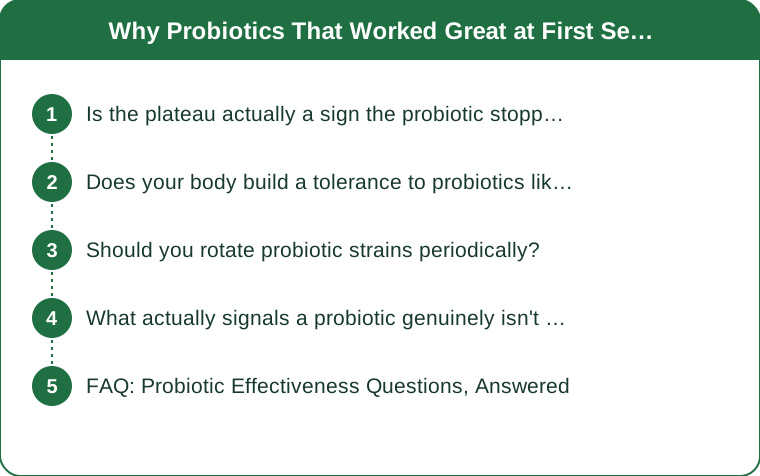
Is the plateau actually a sign the probiotic stopped working?
Not necessarily — probiotic strains don’t typically colonize permanently; they pass through and interact with your existing microbiome, and the initial dramatic shift often reflects your gut’s response to a new stimulus more than the probiotic itself providing an escalating effect over time. A leveled-off, stable-feeling gut can genuinely mean it’s working exactly as intended — maintaining a new equilibrium rather than continuing to produce ever-larger changes.
Does your body build a tolerance to probiotics like it can with some medications?
Not in the same pharmacological sense — there’s no established mechanism for the body developing ‘tolerance’ that blocks probiotic effects. What’s more likely is that noticeable initial symptom relief (like resolved bloating) reflects your gut had a specific correctable issue that’s now resolved, so there’s simply less dramatic improvement left to notice.

Should you rotate probiotic strains periodically?
Some gut health practitioners recommend it, reasoning that different strains support different aspects of gut function and diversity of strains may better support overall microbiome diversity than one strain indefinitely — though the evidence for strain rotation specifically is less established than evidence for probiotics generally.
What actually signals a probiotic genuinely isn’t helping anymore?
A return of the original symptoms it was addressing (bloating, irregularity, discomfort) is the clearest signal something has changed, versus simply not noticing continued dramatic new improvement, which is a normal and expected plateau rather than a failure signal.
FAQ: Probiotic Effectiveness Questions, Answered
How long should you take a probiotic before judging if it’s working?
Most gut health guidance suggests at least 4-8 weeks of consistent use before evaluating effect, since gut flora shifts take time to stabilize.
Does diet affect how well probiotics continue working?
Yes significantly — a diet low in fiber (which feeds beneficial gut bacteria) can blunt probiotic effectiveness regardless of which strain you take.
Is it necessary to take probiotics indefinitely once you feel better?
Not necessarily — some people cycle on and off, though those with chronic digestive issues often continue longer-term under practitioner guidance.
TL;DR:
- A plateau after initial improvement often means your gut reached a new stable equilibrium, not that the probiotic failed
- There’s no established biological ‘tolerance’ mechanism blocking continued probiotic effect
- The real warning sign is original symptoms returning, not simply a lack of new dramatic change
- Diet quality, especially fiber intake, affects how well probiotics keep working over time
Feeling nothing new isn’t nothing — sometimes it’s the quiet sound of a new baseline holding steady.
Keep Reading
This article is for general informational purposes only and is not medical advice. Always consult a qualified health professional for guidance specific to you.