Why Your Digestion Changes in the First Cold Weeks of the Year
Quick Answer: Four things change simultaneously as the weather turns - fiber intake rises sharply with autumn produce, fluid intake falls because you feel less thirsty in cool weather, daily movement drops, and meal timing shifts later. Any one alone is manageable; together they commonly produce two to three weeks of bloating and irregularity. The fastest fix is fluid, not fiber.
It catches people every year, and the usual response - eat more fiber, it must be a fiber problem - frequently makes it considerably worse.
This is general information, not medical advice. Persistent changes in bowel habit are worth discussing with a clinician.

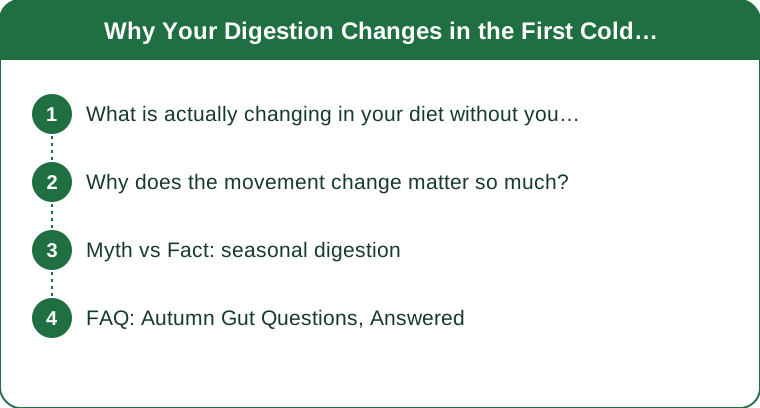
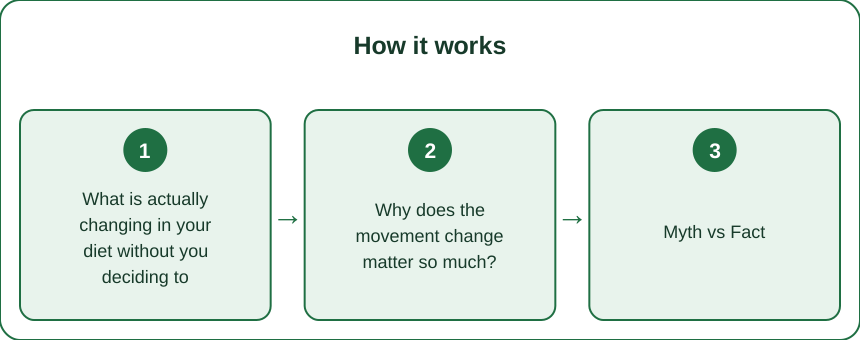
What is actually changing in your diet without you deciding to change it?
Autumn produce is dramatically higher in fiber than summer produce. Salads, berries, melon, and cucumber give way to squash, root vegetables, brassicas, apples, pears, beans, and grains. That transition can raise daily fiber intake by 10 to 15 grams within a couple of weeks without any conscious decision.
Fiber increases need water to work. Soluble fiber forms a gel by absorbing water; insoluble fiber adds bulk that requires water to move. Increase fiber while fluid intake falls and you get exactly the opposite of the intended effect - harder, slower stool and more gas.
And thirst genuinely declines in cool weather. Thirst is driven substantially by heat and visible sweating. In cool weather you still lose fluid through respiration - more, in fact, in dry air - but you feel less thirsty, so intake commonly falls by several cups a day without notice.
Add fermentable carbohydrates. Brassicas, onions, beans, and many autumn staples are high in fermentable carbohydrates that gut bacteria act on to produce gas. The bloating that arrives in October is very often just a rapid change in what your microbiome is being fed - and it does settle as the population adjusts, usually within two to four weeks.
Why does the movement change matter so much?
Physical activity directly stimulates gut motility. Walking in particular increases colonic transit measurably, and daily step counts drop substantially once the weather turns and the evenings get dark. For many people this is a reduction of several thousand steps a day, sustained over months.
Sitting for longer stretches compounds it. Colder weather means more time seated indoors, and prolonged sitting slows transit independently of total activity.
Routine timing shifts too. Later dinners, later mornings, and disrupted schedules affect the gut’s circadian rhythm, which is real and well documented - the digestive system has its own clock, and it prefers consistency. Irregular meal timing is a common and overlooked cause of autumn irregularity.
And warm drinks change things, in both directions. Increased coffee intake stimulates the colon for many people, which can be helpful or can tip into urgency. Increased tea intake, if it replaces water, may not contribute as much fluid as expected depending on the amount and type.
The practical upshot: a 15-minute walk after your largest meal addresses more of this than any dietary supplement. It is the highest-return intervention available and it costs nothing.

Myth vs Fact: seasonal digestion
Myth: Bloating means you are eating something wrong. Fact: bloating from increased fermentable fiber is a sign your microbiome is adapting to a new substrate, not that you are intolerant to it. Eliminating those foods removes the symptom and also removes the adaptation. Reduce the portion, keep the food, and let it settle.
Myth: More fiber is always better. Fact: fiber intake that rises faster than fluid intake and faster than your microbiome can adapt reliably produces symptoms. The rate of increase matters as much as the total. Add roughly 5 grams a week, not 15 at once.
Myth: You need less water in cold weather. Fact: you often need a similar amount. Respiratory water loss increases in cold dry air, and heated indoor environments are dehydrating. Reduced thirst is not reduced requirement.
Myth: Probiotic supplements will fix it. Fact: the evidence for general-purpose probiotics improving normal seasonal irregularity is weak. Fermented foods and a varied fiber intake have better support, and both cost less.
Myth: This is just how autumn is. Fact: most of it resolves within two to four weeks if you address fluid and movement. A change in bowel habit persisting beyond a few weeks, or accompanied by pain, bleeding, or unintended weight loss, is a reason to see a clinician rather than to wait it out.
FAQ: Autumn Gut Questions, Answered
How much water should I actually be drinking in cool weather?
A practical approach is to keep intake roughly where it was in summer and check urine color rather than counting cups - pale straw is the target. Most people find they need to make it deliberate in autumn because thirst is no longer a reliable prompt.
Should I cut out the vegetables that make me gassy?
Generally no, unless symptoms are severe. Cruciferous vegetables and legumes cause gas because they feed beneficial bacteria - the gas is a byproduct of a process you want happening. Reduce portion size, cook them thoroughly, introduce them gradually, and most people find it settles within a few weeks.
Is the bloating I get in autumn the same as a food intolerance?
Usually not. Adaptation bloating improves over two to four weeks of consistent exposure; intolerance does not and tends to be dose-dependent and reproducible. If symptoms are severe, persistent, or accompanied by other changes, that is a conversation for a clinician rather than a self-directed elimination diet.
TL;DR:
- Autumn raises fiber intake by 10 to 15 grams a day without you deciding to, while thirst-driven fluid intake falls.
- Fiber without fluid slows transit and increases gas - fix the fluid first, not the fiber.
- Daily step counts drop sharply; a 15-minute walk after your largest meal is the highest-return fix.
- Bloating from new fermentable foods is adaptation, and usually settles in two to four weeks.
- Persistent change in bowel habit, pain, bleeding, or weight loss warrants a clinician, not patience.
Keep Reading
This article is for general informational purposes only and is not medical advice. Always consult a qualified health professional for guidance specific to you.