Why Your Digestion Shifts in the Last Weeks of Summer
Quick Answer: Digestion commonly shifts at the end of August for four reasons that arrive together. Meal timing changes as schedules resume, and the gut runs on a circadian rhythm that takes days to adjust. Late summer produce is at peak volume and peak fiber, and a rapid fiber increase reliably produces gas and bloating for a week or two. Hydration frequently drops as the weather cools while fiber intake rises, which is the specific combination that causes constipation. And the transition period disrupts sleep, which affects gut motility directly. All four are temporary and all four are manageable.
Everything was fine in July. Now you are bloated most afternoons, less regular than you were, and nothing obvious has changed.
Late August is a genuinely disruptive period for the digestive system, and knowing which of the four causes is yours makes it a short problem rather than a long one.
This is general information, not medical advice.

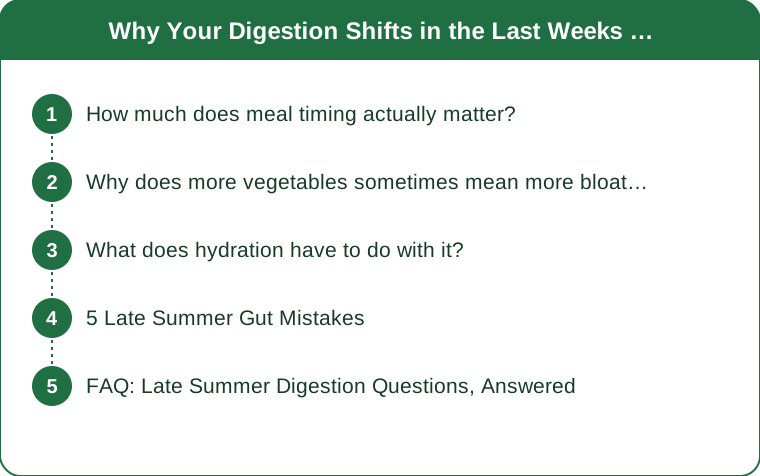
How much does meal timing actually matter?
More than most people expect - the gut runs on its own clock.
The digestive system has a circadian rhythm that governs gastric emptying, enzyme secretion, gut motility and the composition of the microbiome itself. These are not passively responsive to when you eat; they anticipate it.
When meal timing shifts - which it does for most people in late August as school and work schedules resume - the anticipatory system is out of phase with the actual eating for several days. The result is food arriving when digestive capacity is lower, which shows up as bloating, fullness and discomfort after meals that used to be fine.
The migrating motor complex is the other piece. This is the wave of contraction that sweeps the small intestine clean between meals, and it only runs in the fasted state. A summer of grazing suppresses it; a return to structured meals with genuine gaps between them restores it, and the transition can be uncomfortable.
Three to four hours between meals is roughly what allows the sweeping to happen. Constant grazing is one of the more common and least recognized contributors to persistent bloating.
The practical response is to pick a schedule and hold it for two weeks rather than adjusting daily. The system adjusts to consistency, not to optimization.
Why does more vegetables sometimes mean more bloating?
Because a rapid fiber increase outpaces the microbiome’s ability to handle it.
Late August is peak produce, and a lot of people significantly increase their vegetable intake in these weeks. Fiber is fermented by gut bacteria, and fermentation produces gas. That is the mechanism working correctly, not a malfunction.
The problem is speed. The bacterial populations that handle a given fiber type expand over days to weeks, so a sudden doubling of intake means a large amount of substrate arriving for a population that has not scaled yet. The result is gas, distension and discomfort, typically peaking a few hours after eating.
The specific late-summer offenders are the high-FODMAP produce that peaks now: onions, garlic, stone fruit, watermelon, apples, corn and cruciferous vegetables. All are excellent foods and all are highly fermentable.
Increase gradually. Roughly five grams of additional daily fiber per week, held for a week before increasing again, allows the population to keep pace. Going from 15 to 35 grams in a weekend does not.
Cooking helps considerably. Cooked cruciferous vegetables are meaningfully easier to tolerate than raw, and roasting or steaming breaks down some of the fibers before they reach the colon.
And chew properly. This sounds trivial and is not - mechanical breakdown is the first stage of digestion, and inadequate chewing sends larger particles further down, where they ferment more.

What does hydration have to do with it?
It is the difference between fiber helping and fiber hurting.
Soluble fiber works by absorbing water and forming a gel that softens stool and regulates transit. Without adequate water, the same fiber does the opposite - it bulks without softening, and the result is harder stool and slower transit.
Late August is exactly the combination that produces this. Fiber intake is rising with the produce season, and fluid intake is falling as the weather cools and thirst decreases. People stop carrying water bottles in early September without reducing anything else.
The deficit is often carried over from summer as well. Chronic mild dehydration from a hot summer does not resolve automatically when the weather cools - the thirst drive falls before the deficit is made up.
The practical target is enough that urine is pale straw colored through the day. Counting glasses is less useful than that single observation.
There is a caffeine angle worth noting. Coffee intake often rises with the return of work schedules, and while coffee is not the diuretic it is reputed to be at habitual doses, a large increase does have an effect - and coffee also stimulates the gastrocolic reflex, which is why schedule changes involving more coffee produce noticeable changes in timing.
Fiber plus water works. Fiber without water is worse than neither.
5 Late Summer Gut Mistakes
1. Increasing fiber all at once because the produce is good. Covered above, and it is the most common one. Peak season is a reason to increase steadily, not suddenly.
2. Letting hydration follow the weather. Thirst is a lagging indicator and it falls faster than your requirement does. Keep drinking on a summer schedule for another few weeks.
3. Changing meal timing gradually instead of decisively. The gut adapts to consistency. Shifting dinner by an hour every few days keeps the system permanently out of phase - pick the new schedule and commit for two weeks.
4. Blaming a food when the cause is sleep. Late-August schedule transitions cost most people sleep, and short sleep measurably affects gut motility and the microbiome. A week of bloating that coincides with a week of bad sleep is usually about the sleep.
5. Grazing all day. The migrating motor complex only runs when you are not digesting. Continuous snacking - which is very much a summer pattern - suppresses it, and restoring genuine gaps between meals is one of the more effective interventions for persistent bloating.
A useful rule of thumb: change one thing at a time and give it a week. Late August tempts you to change five things at once, and then nothing is diagnosable.
FAQ: Late Summer Digestion Questions, Answered
How long should the adjustment take?
For a schedule change, most people settle within one to two weeks of consistent timing. For a fiber increase, the microbial adaptation takes two to four weeks if the increase is gradual. If discomfort is still significant after a month of consistency, that is the point to seek a clinical opinion rather than continuing to experiment.
Should I cut out the vegetables that cause gas?
Generally no, unless a clinician has advised it. The fermentable fibers causing the gas are also the ones feeding beneficial bacteria, and eliminating them tends to narrow tolerance further over time. Reducing the portion, cooking rather than eating raw, and increasing slowly usually solves it without elimination.
When is bloating actually worth seeing someone about?
Bloating with weight loss, blood, persistent pain, vomiting, fever, or a change in bowel habit lasting more than a few weeks is worth a clinical assessment rather than a dietary experiment. Seasonal bloating that tracks a schedule and diet change and resolves is a different thing from a symptom that persists regardless of what you do.
TL;DR:
- The gut runs on a circadian clock, and late-August schedule changes put it out of phase for several days.
- Peak produce means a fiber jump, and gas is the fermentation working - it just needs the bacteria to catch up.
- Increase fiber by about five grams a week, cook the cruciferous vegetables, and chew properly.
- Fluid intake falls as fiber rises - that specific combination is what causes late-summer constipation.
- Restore gaps between meals so the migrating motor complex can run.
- Suspect sleep before you suspect a food when a bad week coincides with a bad week of sleep.
This is general information, not medical advice. Four things changed at once - fix them one at a time and give each a week.
Keep Reading
This article is for general informational purposes only and is not medical advice. Always consult a qualified health professional for guidance specific to you.