Why Your Digestion Slows Down When You Stop Moving as Much
Quick Answer: Physical movement directly speeds gut transit — walking increases colonic motility, and the drop from a summer average of 9,000 steps to an autumn 4,000 is enough to slow things measurably. Add reduced fluid intake in cool weather and a shift towards heavier food, and autumn constipation and bloating are largely a movement problem wearing a diet costume. A ten-minute walk after meals fixes more of it than any supplement.
The food has not changed much. The bloating and the sluggishness have.
What has actually changed is that you are no longer walking to and from things in the evening light, and your gut notices that faster than it notices anything you ate.

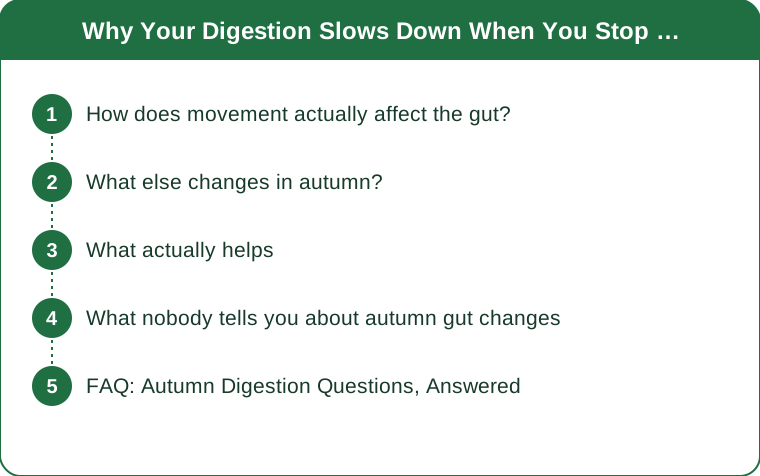
How does movement actually affect the gut?
Through several mechanisms at once, which is why the effect is larger than people expect.
Mechanical agitation. Walking and other upright movement physically jostles the abdominal contents. This is not a trivial contribution — the colon is a mobile organ suspended in the abdomen, and movement of the trunk shifts and mixes its contents in a way that stationary sitting does not.
Increased colonic motility. Exercise measurably increases the frequency of the propagating contractions that move material through the colon. Moderate activity — a brisk walk — appears to do this more reliably than very intense exercise, which can actually slow gastric emptying temporarily by diverting blood flow.
The gastrocolic reflex is enhanced by movement. Eating triggers colonic activity; being upright and moving afterwards amplifies it. This is the physiological basis of the after-dinner walk, which is a habit with considerably more evidence behind it than most digestive folk wisdom.
Core and diaphragm engagement. Breathing during activity moves the diaphragm through a much greater range, and the diaphragm’s movement massages the organs beneath it. Shallow desk breathing does almost none of this.
And there is a stress pathway. Physical activity reduces sympathetic tone, and the gut is heavily influenced by the balance between sympathetic and parasympathetic activity — digestion is a parasympathetic function. Less movement plus more autumn work stress is a double hit on the same system.
What else changes in autumn?
Movement is the largest factor and it does not act alone.
Fluid intake falls, often sharply. People drink noticeably less water in cool weather because thirst is driven substantially by heat. Reduced fluid means harder stool and slower transit, and it is the single most common contributor to autumn constipation. You need roughly the same fluid in October as in July; your thirst does not tell you that.
Fibre type shifts. The summer diet is high in raw vegetables, salads and fruit; the autumn diet moves to cooked, softer, heavier food. Total fibre often falls, and the proportion of insoluble fibre — the type that adds bulk and speeds transit — falls further.
Meal timing gets later and heavier. Evening meals eaten later and closer to bed, with less movement afterwards, is the pattern that produces overnight bloating.
Daylight exposure drops, and with it circadian regularity. The gut has its own circadian rhythm, and motility follows a daily pattern with a strong morning peak. Less morning light exposure and later, more variable mornings flatten that rhythm, which is why a lot of people find their bowel habit becomes less predictable in autumn specifically.
And warm drinks replace cold ones, which is genuinely fine, but caffeine intake often rises with the temperature drop — and caffeine is both a motility stimulant and a mild diuretic, which pulls in two directions at once.

What actually helps
In order of return on effort.
A ten-minute walk after your largest meal. This is the highest-value intervention available and it is almost free. It amplifies the gastrocolic reflex at the moment it is already firing, and it does more for post-meal bloating than any digestive enzyme or supplement.
Fix the fluid deliberately. Set a target rather than relying on thirst, and count warm drinks — herbal tea and water are equivalent for this purpose. Aim for pale straw-coloured urine as the practical marker.
Get the steps back, in whatever form is realistic. The specific number matters less than the difference between sitting for nine hours and not. Two or three walks broken through the day beat one long one for gut purposes, because the effect is about frequency of stimulation rather than total volume.
Keep some insoluble fibre in the autumn diet. Cooked food is fine, but wholegrains, pulses, skins left on vegetables, and some raw component most days maintains the bulk that soft cooked food loses.
Protect the morning. Consistent wake time, morning light, and enough unhurried time for the gut’s natural morning peak to be acted on rather than suppressed. Suppressing the morning urge because you are rushing is one of the most reliable ways to develop sluggish habit, and autumn mornings are exactly when it happens.
And move first thing. Even five minutes of walking or stretching before breakfast interacts with the strong morning motility peak and sets up the day.
What nobody tells you about autumn gut changes
The bloating usually precedes the constipation. Slower transit means more time for fermentation in the colon, which means more gas, which means bloating a week or two before any obvious change in frequency. Bloating that appears with no diet change in late September is often the first sign of a movement drop, and it is easier to fix at that stage.
People blame the food, change the diet, and make it worse. The standard response to autumn bloating is to eliminate something — dairy, gluten, onions. Eliminating foods from an already-narrowing autumn diet reduces fibre diversity, which is the thing the gut microbiome most needs. The commonest outcome is a smaller diet and the same symptoms.
Fibre without fluid makes constipation worse, not better. Adding a fibre supplement while drinking less is actively counterproductive — bulk without water is harder to move. If you increase fibre in autumn, increase fluid first.
Cold weather genuinely reduces appetite regulation accuracy. People eat larger meals with less awareness in cold weather, and larger meals distend the stomach and slow gastric emptying. Meal size is a variable worth watching separately.
And a change in bowel habit that persists for more than a few weeks is worth a conversation with a doctor, particularly with blood, unexplained weight loss, or persistent pain. Seasonal sluggishness resolves when the inputs change; anything that does not is a different question. This is general information, not medical advice.
FAQ: Autumn Digestion Questions, Answered
How many steps do I actually need?
There is no threshold, and the difference between very low and moderate matters more than the difference between moderate and high. Getting from 3,000 to 6,000, spread through the day, produces most of the available benefit for gut transit.
Does the type of exercise matter?
Moderate, upright, rhythmic activity — walking, easy cycling, swimming — is best for motility. Very intense exercise temporarily slows gastric emptying and can cause its own symptoms. For gut purposes, the walk beats the interval session.
Should I take a fibre supplement in autumn?
Food first, and fluid before fibre. If your diet has genuinely lost its fibre with the season, a supplement is reasonable — but increase it slowly and increase water alongside it, or you will feel worse for a fortnight.
Why is it worse in the morning?
It is usually not worse — the morning is when colonic motility naturally peaks, so it is when you notice the system either working or not. A sluggish morning is a symptom of the previous day’s inputs more than of the morning itself.
TL;DR:
- Movement directly drives colonic motility, and the autumn drop in daily steps slows transit more than diet changes do.
- Reduced fluid intake in cool weather is the second-biggest factor, and thirst will not warn you.
- A ten-minute walk after your largest meal is the single highest-return fix available.
- Keep insoluble fibre in the diet, protect an unhurried morning, and increase fluid before you increase fibre.
- Bloating usually arrives before any change in frequency — treat it as an early signal.
This is general information rather than medical advice. A persistent change in bowel habit, or any bleeding, weight loss or ongoing pain, is worth a proper assessment.
Keep Reading
This article is for general informational purposes only and is not medical advice. Always consult a qualified health professional for guidance specific to you.