Why Your Gut Feels Worst on a Monday
Quick Answer: Digestion runs on a circadian schedule, and a weekend of later meals, later sleep, different food, more alcohol, and less routine movement shifts that clock - so Monday is the day your gut is out of phase with your life. The pattern is often called social jetlag, and the fix is not a Monday detox but a smaller weekend shift: keeping breakfast within about an hour of your weekday time and protecting the first meal is more effective than anything you do on Monday itself.
Same body, same food on Monday as on Thursday, completely different outcome.
What changed happened on Saturday.

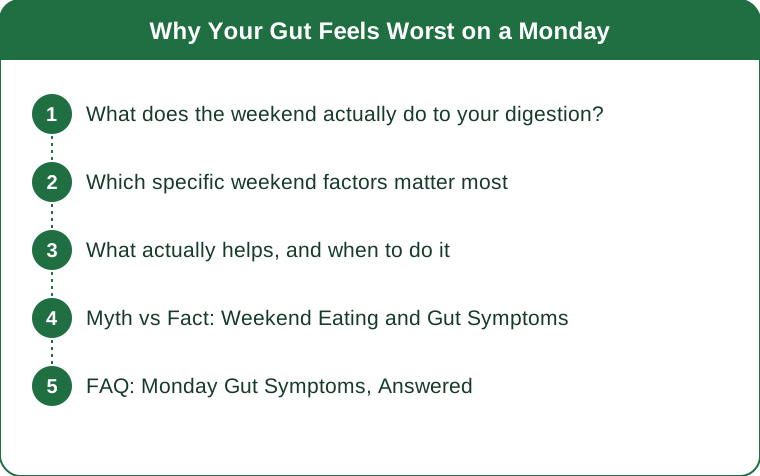
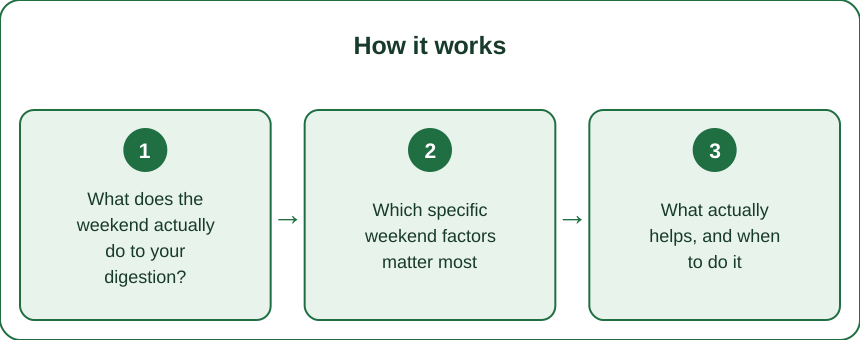
What does the weekend actually do to your digestion?
Your gut has its own circadian rhythm, with motility, enzyme secretion, and gut microbial activity all varying predictably across a 24-hour cycle.
Meal timing is the strongest signal that sets that rhythm - stronger than light exposure for the digestive system specifically. Move your meals and you move the clock.
A weekend typically shifts everything one to three hours later. Later breakfast, later dinner, later bedtime. That is a meaningful phase shift, repeated every week.
Then Monday snaps everything back abruptly, and your digestive system is operating on Saturday’s schedule while you eat on Monday’s.
The gut microbiome shows daily rhythms too, and irregular feeding patterns disrupt them. This is an active research area rather than settled fact, but the direction is consistent.
Add the direct effects and it compounds: alcohol, richer food, more of it, later, plus less routine walking than a normal working day involves.
Which specific weekend factors matter most
Meal timing irregularity is probably the biggest single lever, because it is the signal that sets the clock rather than just adding load.
Alcohol affects the gut directly and via sleep. It irritates the gut lining, alters motility, and fragments sleep - and poor sleep independently worsens gut symptoms the following day.
Sleep disruption is a large factor on its own. Two nights of later, poorer sleep raises gut sensitivity and lowers the threshold at which normal digestive sensations register as discomfort.
Food composition changes more than people credit. Weekend eating tends to be higher in fat, lower in fibre, and more likely to include foods you rarely eat - and unfamiliar foods produce more variable responses.
Movement drops substantially. A working day includes a surprising amount of incidental walking, and movement supports gut motility directly. Two sedentary days show up.
Skipping or delaying breakfast on weekend mornings is a specific culprit, because the morning meal is one of the strongest timing cues your digestive system receives.
And stress reverses direction on Monday, with the return of work-related stress affecting gut sensitivity through the gut-brain axis at the same moment everything else is out of phase.

What actually helps, and when to do it
Keep weekend breakfast within about an hour of your weekday time. This is the single most effective intervention and it costs very little - you can still have a slow morning, just eat something near the usual hour.
Protect the last meal time more than the first, if you have to choose. A very late Saturday dinner shifts the following morning more than a slightly late breakfast does.
Do not compensate with a Monday restriction. Skipping breakfast or eating very little on Monday to make up for the weekend deepens the irregularity rather than correcting it.
Keep fibre going over the weekend. It is the thing most likely to drop, and a two-day gap is enough to be noticeable by Monday for many people.
Walk on both weekend days, even briefly. Twenty minutes after a meal supports motility and replaces some of the incidental movement a working day provides.
Hydrate on Sunday specifically, which is the day most likely to follow alcohol and least likely to include a normal drinking routine.
And give it three to four weeks before judging. A rhythm re-established over a month produces a much clearer answer than a single well-behaved weekend, and the pattern is easier to see in a simple log than in memory. Persistent digestive symptoms, unexplained weight loss, blood in the stool, or a significant change in bowel habit should be checked by a clinician rather than managed with routine adjustments. This is general information, not medical advice.
Myth vs Fact: Weekend Eating and Gut Symptoms
Myth: It is just the rich food. Fact: food composition matters, but timing irregularity is a distinct and probably larger factor. People eating identical food on a consistent schedule frequently report fewer symptoms than those eating better food erratically.
Myth: A Monday fast resets things. Fact: it adds another irregularity on top of an existing one. Returning to a normal schedule promptly is more effective than compensating.
Myth: You need a weekend as strict as your weekdays. Fact: keeping breakfast within about an hour of the usual time captures most of the benefit without requiring a rigid weekend.
Myth: Alcohol only matters in large amounts. Fact: moderate amounts affect gut lining, motility, and sleep quality, and the sleep effect alone worsens next-day symptoms for many people.
Myth: Bloating on Monday means a food intolerance. Fact: it far more often reflects timing, sleep, alcohol, reduced movement, and stress arriving together. Eliminating foods based on a Monday pattern usually removes the wrong variable.
Myth: It will settle on its own if you ignore it. Fact: the pattern repeats every week because the cause repeats every week. Nothing changes unless the weekend does.
FAQ: Monday Gut Symptoms, Answered
Why is my digestion worse on Mondays?
Digestion follows a circadian rhythm set largely by meal timing. A weekend of later meals, later sleep, alcohol, different food, and less movement shifts that rhythm, so Monday finds your gut running on Saturday’s schedule.
What is the single most useful change?
Eating breakfast within about an hour of your weekday time on both weekend days. Meal timing is the strongest signal your digestive clock receives.
Should I eat lightly on Monday to compensate?
No. Restricting on Monday adds another irregularity on top of the one causing the problem. Return to your normal schedule instead.
Is alcohol or sleep the bigger factor?
They are hard to separate, because alcohol disrupts sleep and poor sleep independently increases gut sensitivity. Both belong in the picture, and reducing either helps.
Does it mean I have a food intolerance?
Usually not. A Monday-specific pattern points to timing, sleep, alcohol, movement, and stress arriving together rather than to a specific food. Eliminating foods on this evidence typically removes the wrong variable.
When should I see someone?
Persistent symptoms, unexplained weight loss, blood in the stool, or a significant change in bowel habit should be assessed by a clinician. This is general information, not medical advice.
TL;DR:
- Digestion runs on a circadian clock set largely by meal timing, and a weekend shifts it one to three hours later.
- Monday is when your gut is out of phase with your life - the cause happened on Saturday.
- Alcohol, poorer sleep, lower fibre, less incidental movement, and returning stress all stack on top.
- Keeping weekend breakfast within an hour of your weekday time captures most of the available benefit.
- Do not compensate with a Monday restriction; that adds a second irregularity to the first.
- Persistent symptoms, weight loss, blood, or a changed bowel habit need a clinician. This is general information, not medical advice.
You do not have a Monday problem. You have a Saturday schedule.
Keep Reading
This article is for general informational purposes only and is not medical advice. Always consult a qualified health professional for guidance specific to you.